
The best way to visit
If you are planning a visit to Saint-Émilion, the question is almost inevitable:
Should we go without a car, rent one, or choose something in between?
It may sound like a practical detail, but in reality, this decision shapes your entire experience — what you see, how you move, how much you taste, and how deeply you understand the region.
I work here regularly, guiding travelers through the vineyards and the village, and I’ve seen all versions of this day. Some are simple and spontaneous, others more structured, some surprisingly limited, others incredibly rich.
So let me walk you through it — honestly and without trying to push you in one direction.
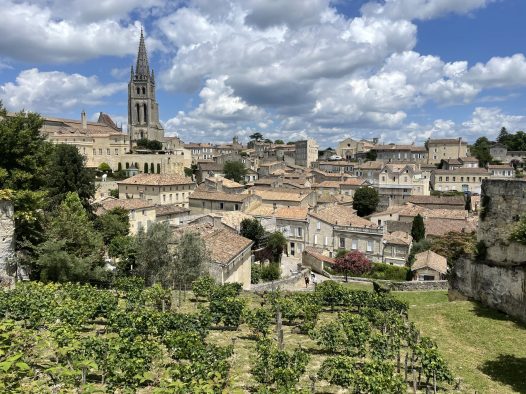
First, What Is Saint-Émilion Really?
Before we compare transport options, it’s important to understand one thing:
Saint-Émilion is not just a town.
It is an appellation — a protected wine region with its own identity, rules, and classification system. The vineyards stretch far beyond the small medieval town that most visitors see.
When you stand in the center, surrounded by stone houses and wine shops, it’s easy to think you’ve “arrived.”
But in reality, you’re only seeing a small part of it.
The real Saint-Émilion is:
— rolling vineyards in every direction
— small family estates and large prestigious châteaux
— a mix of tradition and modern winemaking
And this is where your choice — car or no car — starts to matter.
Visiting Without a Car
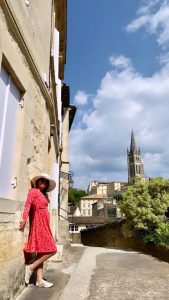
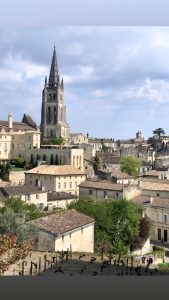
Arriving without a car is, in many ways, the simplest way to reach Saint-Émilion. The train from Bordeaux is short, direct, and relatively inexpensive. It allows you to travel lightly, without planning too much, without thinking about roads or directions.
There is a certain pleasure in that kind of independence. You arrive with no obligations, no fixed itinerary. The day unfolds slowly.
The station itself is quiet, surrounded by open countryside. From there, the path to the village begins. It takes some time, and the final stretch rises gently uphill. It is not difficult, but it reminds you that Saint-Émilion is not designed around convenience. It existed long before modern transport, and in some ways, it still feels that way.
When you reach the village, the impression is immediate. Stone buildings, narrow streets, uneven ground under your feet. It feels compact, almost enclosed, as if everything is gathered within a small space.
Without a car, your experience naturally centers around this village.
You move slowly, often without a plan. You pass wine shops, small cellars open to visitors, terraces where people sit for long lunches. The pace is unhurried. There is time to stop, to taste, to observe.
There are a few places where the atmosphere lingers a little longer. Restaurants such as Le Tertre or Logis de la Cadène offer very different experiences, yet both reflect the rhythm of the village. One feels relaxed and almost hidden, the other more refined, rooted in tradition. In both cases, lunch becomes something you don’t rush.
And then there is another way to experience the landscape, even without going far.
Some visitors choose a simple picnic.
A bottle of wine from a local shop, fresh bread, cheese, maybe something from a small craft shops. You walk just beyond the center, where the village softens into vineyards, and sit between rows of vines or on a quiet edge overlooking the fields. It is not an organized experience, but often one of the most memorable. There is no structure, no explanation, just the landscape and time.
And yet, after a few hours, a quiet realization often appears.
Beyond the village, there is more. Much more.
You see vineyards from a distance, just beyond the edges of the town. Rows of vines following the curves of the land, changing color with the seasons. But reaching them is not always easy.
This is the main limitation of visiting without a car. The landscape is visible, but not always accessible.
Some visitors rent a bicycle, and this changes the experience in a subtle but important way. Moving through the vineyards by bike brings a sense of immersion that walking alone cannot provide. The distances become manageable, the roads quieter, the connection to the land more immediate.
There is also another, more unexpected option. Small electric vehicles, often called tuk-tuks, move through the area with a quiet, almost effortless motion. Sitting in one of them, you are carried through the vineyards without needing to think about direction or distance. It is a simple, almost playful way to extend your visit beyond the village.
Still, without a car, your day remains naturally limited in scope. It can be beautiful, relaxed, and complete in its own way. But it often remains focused on the visible surface of Saint-Émilion, rather than its full depth.
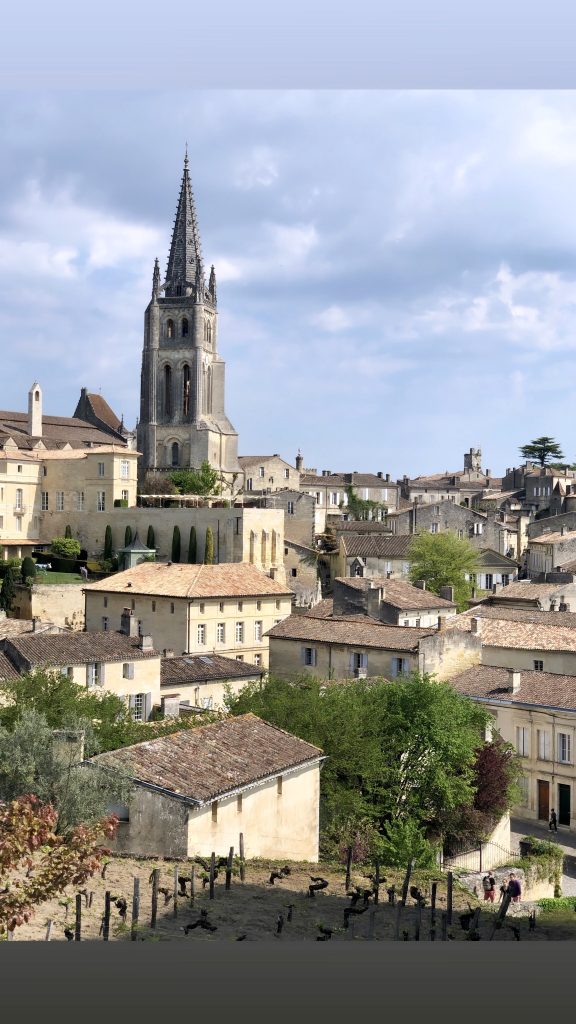
With a Car
Arriving with a car transforms the experience before you even reach the village.
Leaving Bordeaux, the transition is gradual. The city fades, the roads open, and then, almost without noticing, the vineyards begin. At first they appear in small patches, then more consistently, until they define the entire landscape.
This is when Saint-Émilion starts to reveal itself properly.
The appellation is vast, much larger than most visitors expect. Vineyards extend in every direction, covering hills, slopes, and plateaus. Each plot is carefully maintained, each row of vines aligned with intention. It is not a wild landscape, but a cultivated one, shaped over centuries.
With a car, you are no longer confined to the village. You can move through this landscape, stop where you wish, follow small roads that seem to lead nowhere and yet always pass another estate, another château, another variation of the same land.
Some estates are easier to access and often welcome visitors with structured tastings. Places like Château La Dominique combine modern architecture with traditional vineyards, creating a contrast that many visitors find interesting. Others, like Château Coutet, offer a quieter, more classical experience, closer to what people imagine when they think of Bordeaux wines.
Closer to the village, there are also smaller, family-run châteaux that feel more intimate. These are often the places where conversations last longer, where the visit feels less formal and more personal. Some of them can be reached even without going far from the center, but most still require planning.
Because this is something important to keep in mind: visits to châteaux usually require booking in advance. Without it, access is not guaranteed.
There is, however, a small exception to this rule. In the village, the tourist office organizes daily tastings with selected wineries. These “châteaux of the day” allow visitors to discover local wines without prior reservation. It is a practical solution, especially if your visit is spontaneous.
With a car, the region opens up. But it also asks for a different kind of attention. You begin to plan more carefully, to choose where to go, how much time to spend, how to balance movement and rest.
And then there is always the same quiet question in the background.
How much should you taste, if you still need to drive?
Also you cant drive in the city. There are parkings around, all you need to pay.
With a Guide
There is another way to experience Saint-Émilion, one that sits somewhere between independence and structure.
In this case, the day is not defined by transport, but by flow.
The vineyards are no longer something you need to reach — they become part of the journey from the very beginning. Stops happen naturally, not because they were planned on a map, but because they are worth it in the moment.
Visits to châteaux are arranged in advance, which removes uncertainty. You arrive expected, not just passing by. The experience feels more continuous, less fragmented.
And yet, what often stays with people is not only the wine or the places, but the sense of coherence. The village, the vineyards, the tastings, the conversations — everything connects more easily. On the way you learn about the history of the terroir, what is the difference between classifications, how better to pair wine and food and more fun facts and details.
Final Thoughts
Saint-Émilion does not impose a single way of being experienced.
You can spend the day entirely within the village, moving slowly, enjoying a long lunch, perhaps ending with a quiet picnic among the vines.
You can explore the wider landscape, driving through vineyards, discovering châteaux, understanding the scale of the appellation.
Or you can approach it in a more guided way, where the different elements come together into a more complete story.
None of these options is wrong. They simply reveal different versions of the same place.
And perhaps that is what makes Saint-Émilion so interesting — not only what it is, but how differently it can be experienced depending on how you choose to arrive.
Your local guide from Bordeaux — Marina
You can find additional infeotmation in my Instagram: https://www.instagram.com/bordeaux_with_marina/